Right now your skis are probably leaning in a garage corner, edges resting on concrete, tips wedged behind a bike. Your snowboard is flat under a workbench collecting dust. You won't think about either one until the first storm warning in November.
That's exactly how good gear goes bad in the off-season.
Summer is the easiest time to set up storage right, and the worst time to ignore it. Six months of bad storage does real damage you'll discover the day you want to ride.
Why Off-Season Storage Actually Matters
A few things go wrong when winter gear sits wrong all summer:
Edges rust. Metal edges sitting against damp concrete or stored wet will spot with rust over a humid summer. Light surface rust means a tune-up before you ride. Heavy rust means pitted edges that never hold the same.
Bases dry out and warp. Skis and boards leaned at odd angles or stacked under weight can take a set, a slight warp that affects how they ride. Heat in an uninsulated garage or attic makes it worse.
Gear gets damaged and lost. A pile in the corner gets stepped on, knocked over, and buried under the summer stuff. Bindings get cracked, goggles get scratched, and somehow one glove always disappears.
Getting it up off the floor and organized solves most of this at once.
Where Not to Store It
Before the where-to, a quick word on the spots people default to that quietly wreck gear.
The attic is the worst offender. Summer attic temperatures can climb past 130 degrees, and that kind of sustained heat softens base material, stresses adhesives, and can warp a ski or board left lying flat against a hot surface. If the attic is your only option, a hard case offers some protection, but it's still the riskiest choice.
A damp basement is the other trap. Concrete floors wick moisture, and standing gear against a basement wall in summer humidity is how edges rust and bindings corrode. Garages land in the middle, fine if the gear is up off the floor and out of the most humid corner, less fine if it's piled on the slab.
The sweet spot is cool, dry, and off the floor. A conditioned closet or an interior garage wall beats an attic or a basement every time.
Get It Off the Floor
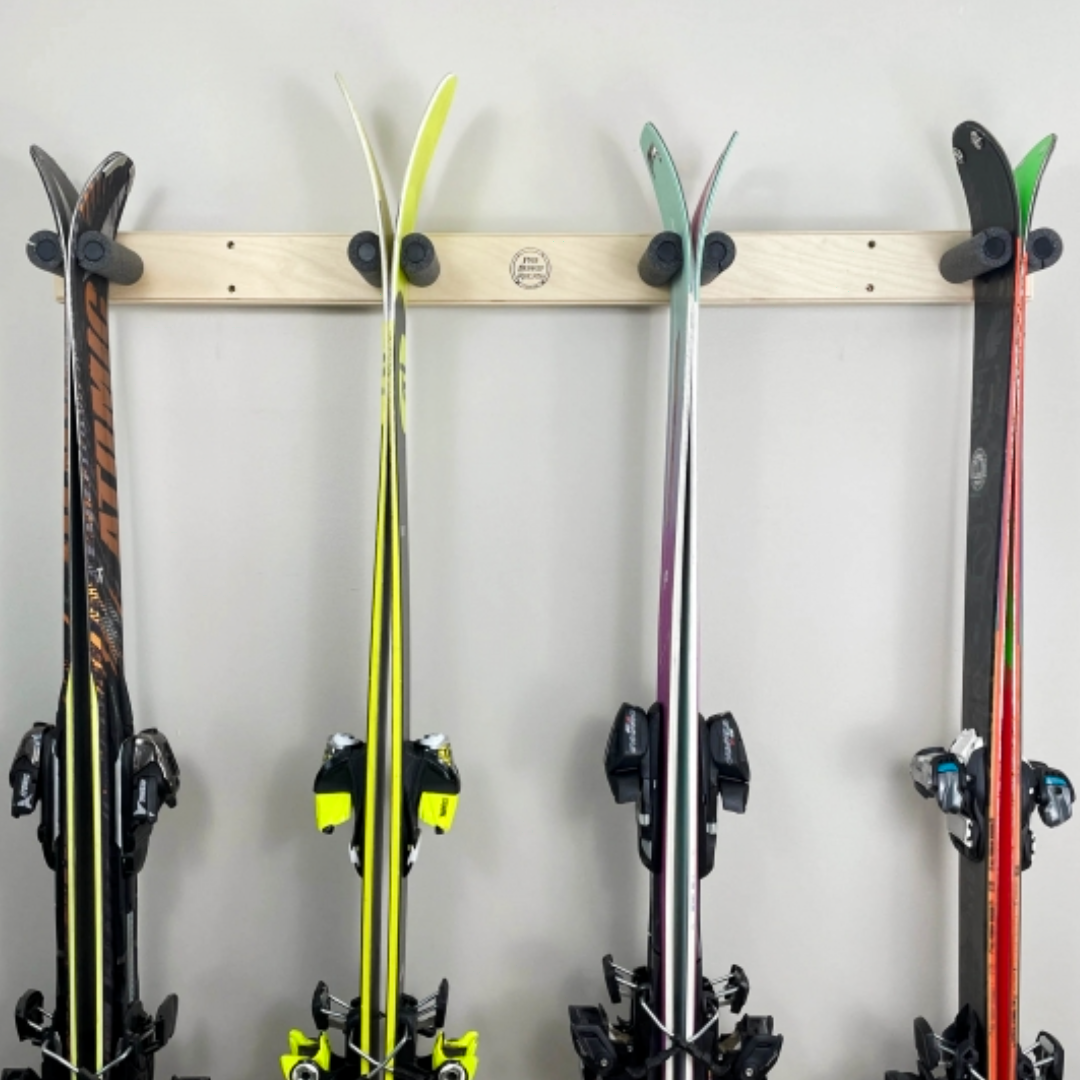
The simplest fix is a wall rack. A ski storage rack or snowboard rack holds your gear flat against the wall, off the damp floor and out of the traffic path, where air can circulate around it.
For households with several setups, modular ski and snowboard storage lets you build out wall space to fit the whole family's gear instead of fighting over one corner. Our broader take on organizing gear with storage racks covers how to lay out a garage or mudroom so everything has a home.
Your Summer Boards Use the Same Wall
Here's the part that makes a rack worth it year-round: the wall you free up in summer isn't empty. The same style of rack holds your warm-weather gear. We carry racks for surfboards, wakeboards, and skateboards and longboards, so the skis go up in spring as the surf and wake gear comes down. One organized wall, two seasons, no pile in the corner ever.
Browse the full storage rack lineup to see what fits your space.
Small Space, Same Problem
You don't need a big garage to store gear right. Apartments and condos are actually where gear gets abused the most, because there's nowhere obvious to put it, so it ends up behind the couch or jammed in a coat closet taking the brunt of every door swing.
Vertical wall storage is the answer in tight quarters. A rack on an unused stretch of wall, in a hallway, an entry, or even a bedroom, turns dead vertical space into a clean home for gear and keeps it off the floor where it gets kicked. Skis and boards stored flat against a wall take up surprisingly little room and look intentional rather than cluttered.
Long-Term and Travel Storage
If gear is going into deep storage, a closet, or onto a plane next season, a hard case is worth it. A Sportube travel case protects skis and boards from crushing and impact in long-term storage and survives airline baggage handling when you finally book that trip. A case also keeps dust and moisture off gear that's going to sit untouched for months.
While You're In There: Batteries and Apparel
Skis and boards aren't the only winter gear sitting idle. If you ride with heated socks, gloves, or jackets, summer is when those batteries need attention so they don't degrade in storage. Our guide on storing heated clothing and batteries for next winter walks through charge levels and storage conditions that keep your power packs healthy. Five minutes now saves you a dead battery on the first cold morning.
A Quick Pre-Storage Checklist
Before anything goes on the rack for the summer:
Wipe down and fully dry every metal surface. Moisture is what causes the rust, so dry beats wet every time.
Wax the bases of skis and boards, or have a shop do it. A coat of wax seals the base against drying out over a long off-season, and you scrape it off before the first run.
Loosen ski binding tension if your bindings allow it, to take stress off the springs through the months they're not in use.
Check boots and pull the liners to dry, and store them buckled loosely so they hold their shape.
Store flat or hanging, never leaned at an angle under their own weight, and keep them out of the hottest, most humid spots.
Next Steps
Off-season storage is a 20-minute summer job that saves you a frustrating discovery and a tune-up bill in the fall. Get the gear off the floor, dry it down, and put it somewhere it can wait.
Browse storage racks for every kind of gear to find what fits your wall. Working with tight space or a big collection? Contact us and we'll help you plan it out.
Disclaimer: Always follow your equipment manufacturer's care and storage recommendations. Waxing, binding adjustment, and edge care are best handled by a qualified shop if you're unsure.